Benefits of Urtica himalayensis Nettle Tea: A Beginner’s Guide
If you’ve never tried nettle tea before, the name can be slightly confusing.
The word “nettle” usually brings to mind a plant you wouldn’t want to touch. Fresh nettle leaves are famous for the tiny stinging hairs that can cause an unpleasant reaction when handled. Yet once properly dried and prepared, nettle becomes a surprisingly pleasant herbal tea.
And there is more than one kind of nettle.
In the Himalayas, a distinct species known as Urtica himalayensis grows naturally across parts of the mountain region. It belongs to the same Urtica genus as the better-known common nettle, Urtica dioica, but it is a different species. Botanical records recognise Urtica himalayensis as native to areas including the West Himalaya, East Himalaya, Nepal, Tibet and parts of China.
For someone discovering Himalayan nettle tea for the first time, the obvious question is: what are the benefits?
There is an important point to understand before we get into them. Research on nettle plants has identified interesting nutritional and phytochemical properties, but much of the scientific literature focuses on Urtica dioica and other nettle species rather than Urtica himalayensis specifically. Researchers have found promising effects in laboratory and preclinical studies, but the evidence isn’t strong enough to describe nettle tea as a treatment for medical conditions.
So, rather than making exaggerated promises, let’s look at what makes Himalayan nettle tea interesting and how it can fit into everyday life.
What Is Urtica himalayensis?
Urtica himalayensis is a perennial plant belonging to the nettle family, Urticaceae.
It is naturally associated with Himalayan and nearby mountain regions. Unlike the common nettle that many people may encounter in gardens, fields or woodland, Himalayan nettle has its own geographical range and growing environment.
That origin is one of the reasons Himalayan nettle has attracted attention from herbal tea enthusiasts.
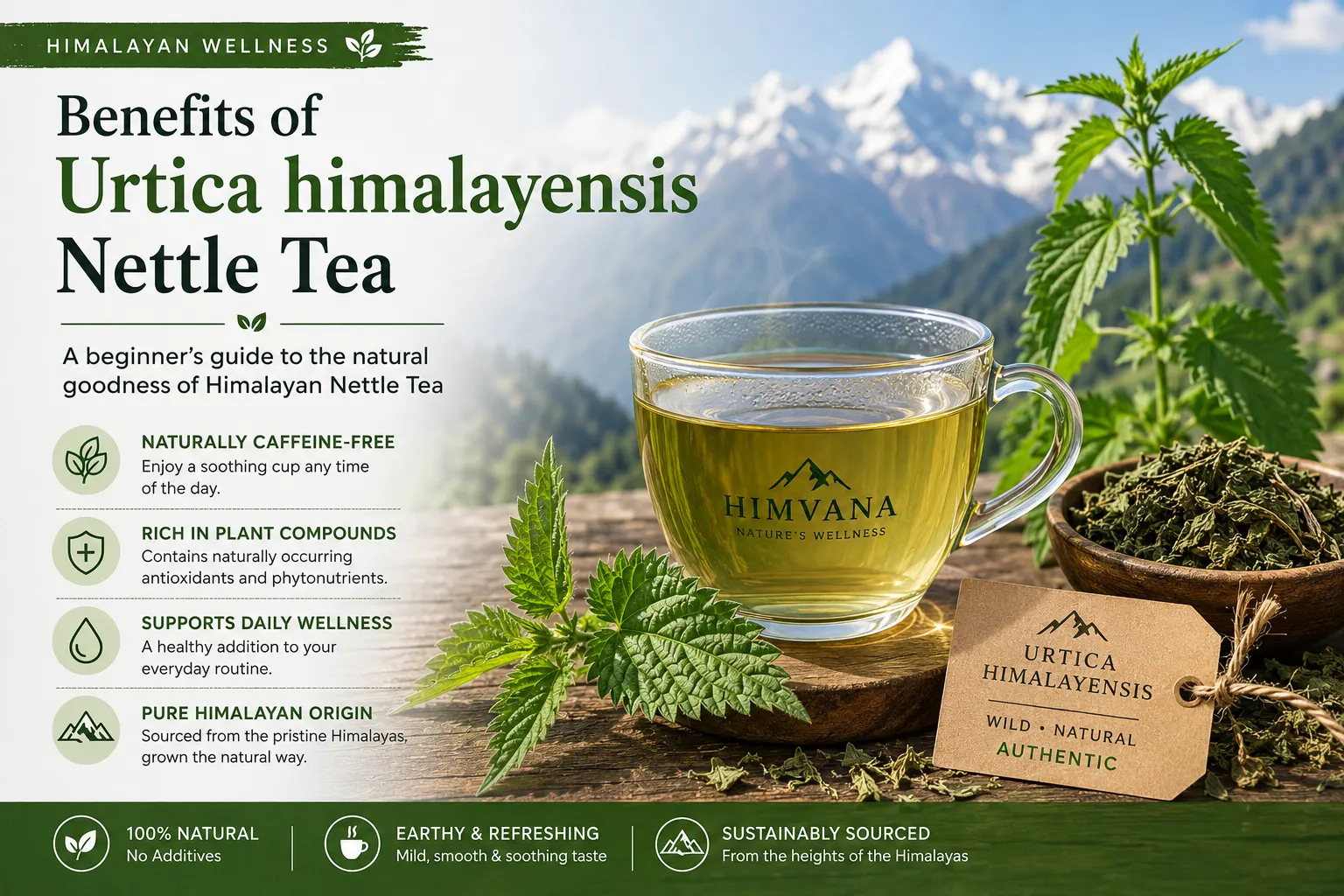
At Himvana, we use Urtica himalayensis as the foundation of our Himalayan Nettle Tea. The aim is simple: preserve the natural character of the leaves and offer an authentic herbal infusion rather than turning it into something heavily flavored or processed.
1. It Is Naturally Caffeine-Free
This is one of the simplest benefits—and one that doesn’t require complicated science.
Pure nettle tea is naturally caffeine-free.
That makes it an easy alternative for someone who enjoys having a warm drink but doesn’t want another cup of coffee or conventional tea.
You can have it in the morning, during an afternoon break or as part of an evening routine without adding another source of caffeine to your day.
For people trying to reduce their caffeine intake, that can be a very practical reason to keep nettle tea in the kitchen.
2. It Can Be Part of a Healthy Hydration Routine
Let’s not overlook the simplest benefit of drinking tea: you’re drinking a fluid.
For someone who finds plain water boring, an unsweetened herbal tea can make staying hydrated more enjoyable.
A warm cup of Himalayan nettle tea can replace a sugary drink or another heavily caffeinated beverage. You don’t need to turn it into a complicated wellness ritual. Sometimes it’s simply a better drink choice.
Of course, water should still remain an important part of your daily fluid intake.
3. Nettle Has a Long History of Traditional Use
Nettle isn’t a new discovery.
Different nettle species have been used traditionally as foods, fibres and herbal preparations for generations. Modern research has also investigated various nettle preparations for their potential biological effects.
This long history is interesting because it shows how closely people have interacted with plants long before modern wellness trends appeared.
At the same time, traditional use and scientific proof aren’t the same thing.
A plant being traditionally used for a particular purpose doesn’t automatically mean that modern clinical research has confirmed the same effect. That’s why it’s better to appreciate nettle’s traditional history while keeping health claims realistic.
4. Nettle Contains Naturally Occurring Minerals and Nutrients
Nettle leaves are known to contain a range of naturally occurring nutrients and minerals.
Research on nettle species has identified compounds and nutrients including minerals, vitamins, chlorophyll and various phenolic compounds. However, the amount that ends up in a cup of tea depends on several factors, including the plant material used and how the tea is prepared.
This is an important distinction.
A nettle leaf may contain a particular nutrient, but that doesn’t mean a cup of nettle tea provides a large nutritional dose of it.
Think of nettle tea as a naturally derived herbal beverage—not a replacement for a varied diet.
5. It Contains Plant Compounds Being Studied for Antioxidant Activity
This is where nettle research becomes particularly interesting.
Laboratory and preclinical research has investigated antioxidant and anti-inflammatory properties associated with nettle preparations. However, reviews of the evidence have also pointed out that stronger human clinical research is needed before these effects can be translated into definite health claims.
For a beginner, the takeaway is quite simple:
Nettle contains interesting natural compounds, but promising laboratory findings should not be confused with proven medical benefits from drinking nettle tea.
That’s a much more useful way to look at herbal tea.
6. It Can Be a Simple Addition to a More Natural Lifestyle
There’s another benefit that doesn’t show up in a laboratory report.
Tea can become a habit.
You boil water, let the leaves steep, sit down for a few minutes and actually take a break.
For someone trying to reduce sugary drinks or cut down on coffee, replacing one drink with an unsweetened herbal tea can be a small but realistic lifestyle change.
You don’t need to completely change your routine overnight.
Sometimes one better choice repeated regularly is more useful than a dramatic health plan that lasts two weeks.
What Makes Himalayan Nettle Different?
If you’ve already tried common nettle tea, you might wonder whether Urtica himalayensis is simply another name for the same plant.
It isn’t.
Urtica himalayensis is recognised botanically as its own species. Its natural range includes Himalayan regions and extends into parts of China and Sumatera.
The difference matters because plant species, geography and growing conditions can all influence the characteristics of botanical ingredients.
That’s also why we believe the origin of an herbal tea deserves attention.
Himvana Himalayan Nettle Tea is made from Urtica himalayensis sourced from the Himalayan region. Rather than treating the Himalayan name as just a marketing label, we want the ingredient itself to be the centre of the story.
What Does Himalayan Nettle Tea Taste Like?
If the word “nettle” makes you expect something harsh or bitter, you may be surprised.
Once dried and brewed, nettle leaves produce a gentle herbal infusion with fresh, earthy and slightly grassy notes.
The flavour isn’t as strong as some herbal teas, which makes it relatively easy for beginners to approach.
You can drink it plain, or add a little lemon or honey if you prefer.
Personally, starting with the tea without additions is the best way to understand its natural character. Once you’ve tried it that way, you can decide whether you want to change the flavour.
How to Brew Urtica himalayensis Nettle Tea
You don’t need special equipment.
For loose-leaf nettle tea, place approximately one teaspoon of dried leaves into a tea infuser.
Pour hot water over the leaves and allow them to steep for around five minutes.
Then remove the leaves and enjoy.
If you’re using tea bags, simply follow the brewing instructions provided with the product.
The longer you steep the tea, the stronger the flavour will generally become. If you’re new to nettle tea, starting with a moderate steeping time is a good way to discover whether you prefer a lighter or stronger cup.
How Often Can You Drink It?
For most healthy adults, nettle tea can be enjoyed as part of a normal beverage routine.
If you’re new to herbal tea, there’s no need to overdo it. Start with a cup and see how you like the flavour and how your body responds.
And remember that herbal tea should complement a balanced diet—not replace it.
At Himvana, we think honesty matters more than making a bigger claim.
Nettle is a fascinating plant with a long history, an interesting nutritional profile and promising areas of scientific research. That’s enough to make it worth exploring without calling it a miracle ingredient.
Frequently Asked Questions
What are the main benefits of Urtica himalayensis nettle tea?
Himalayan nettle tea is naturally caffeine-free and contains naturally occurring plant compounds. Nettle species are also being studied for their antioxidant and other biological properties. However, most clinical research has focused on nettle species such as Urtica dioica, so specific health benefits of Urtica himalayensis tea should not be overstated.
Is Urtica himalayensis the same as Urtica dioica?
No. They are different species within the Urtica genus. Urtica himalayensis is native to Himalayan and surrounding regions, while Urtica dioica has a much wider distribution.
Does Himalayan nettle tea contain caffeine?
Pure nettle leaf tea is naturally caffeine-free.
Can beginners drink Himalayan nettle tea?
Yes. If you’re new to nettle tea, start with a normal cup and see how you enjoy the flavour. If you take medication or have a medical condition, speak with your healthcare professional before consuming it regularly.
Final Thoughts
Nettle is one of those plants that becomes more interesting the more you learn about it.
It has an unusual reputation: a plant that can sting you when fresh, yet has been used as food, fibre and an herbal ingredient for generations.
And Himalayan nettle adds another layer to that story.
Urtica himalayensis is a distinct nettle species associated with the Himalayan region, and its natural origin is an important part of what makes it interesting.
If you’re looking for a caffeine-free herbal tea with a clean, earthy character, Himalayan nettle is worth trying.
Just keep the health claims in perspective. It isn’t a miracle cure, and it doesn’t need to be.
A good herbal tea can simply be a good herbal tea—made from an interesting plant, carefully prepared and enjoyed as part of an otherwise balanced lifestyle.
That’s exactly how we look at Himalayan Nettle Tea at Himvana.