🌿 100% Pure Urtica Himalayensis • No Additives • No Artificial Flavours 🍃 Naturally Caffeine-Free • Rich in Himalayan Goodness 🚚 Free Shipping Across India 🌿 100% Pure Urtica Himalayensis • No Additives • No Artificial Flavours 🍃 Naturally Caffeine-Free • Rich in Himalayan Goodness 🚚 Free Shipping Across India
🎉 Get ₹50 OFF on your Himvana order! Use code HIMFIRST50 at checkout.
If you’ve been exploring nettle tea, you’ve probably come across two botanical names: Urtica himalayensis and Urtica dioica. At first glance, they seem almost identical. Both belong to the nettle family, both are known for their nutrient-rich leaves, and both have been used in traditional herbal practices for centuries.
So, what exactly is the difference? And more importantly, which one is better for your daily cup of tea?
Let’s take a closer look.
Understanding the Two Species
Urtica dioica, commonly known as Common Stinging Nettle, is the best-known nettle species worldwide. It grows naturally across Europe, North America, and parts of Asia. Because of its widespread availability, it is the variety most commonly used in commercial nettle tea products.
Urtica himalayensis, on the other hand, is a species native to the Himalayan region. It grows in the clean mountain environment of India and neighboring Himalayan countries, often at elevations between 7,000 and 10,000 feet. In many Himalayan villages, it has been valued for generations as both a traditional food and an herbal infusion.
Although they belong to the same genus, they grow in different environments and have developed their own unique characteristics.
Urtica dioica thrives in temperate regions around the world and can often be found growing along roadsides, forests, fields, and riverbanks.
Urtica himalayensis naturally grows in the high-altitude Himalayan mountains, where cooler temperatures, mineral-rich soil, and cleaner air create a unique growing environment. Many people believe these natural conditions contribute to the quality of the leaves.
2. Appearance
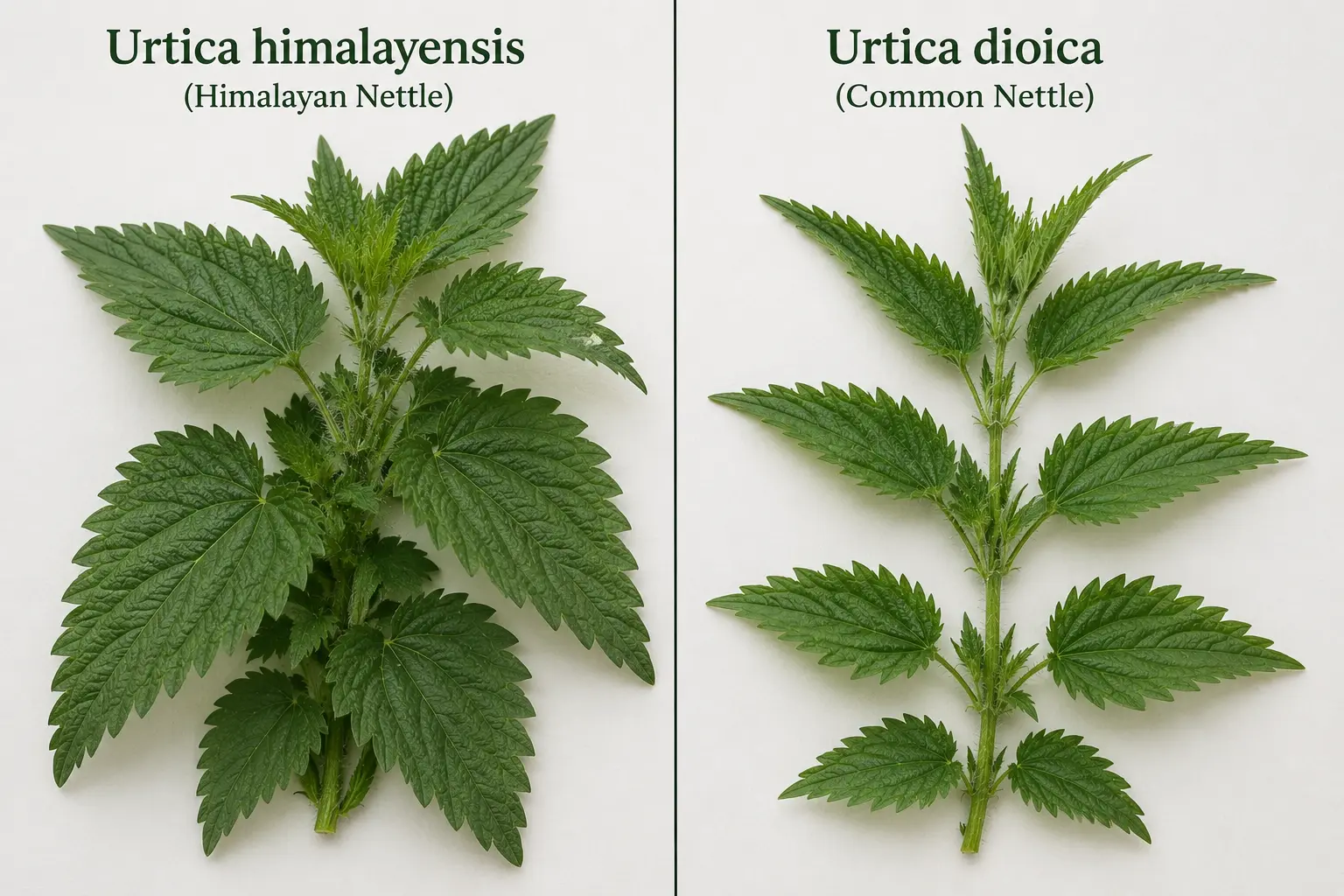
Both plants have the familiar serrated green leaves and tiny stinging hairs that nettles are known for.
However, Urtica himalayensis or Himalayan Nettle often develops slightly larger leaves and are Dark Green in color which offers better taste and healing ability.
3. Nutritional Profile
Both species are naturally rich in nutrients such as:
Protein
Iron
Calcium
Magnesium
Fiber
Vitamins
Polyphenols
Both nettle species are packed with natural nutrients. However, the actual nutritional value depends more on factors like the climate, soil, harvest time, and processing methods than on the species alone.
4. Taste
The flavor profile is another area where some tea drinkers notice a difference.
Common nettle tea made from Urtica dioica usually has a mild, grassy taste similar to green leafy vegetables.
Tea prepared from Urtica himalayensis is often described as smoother, earthier, and slightly richer. Since it grows in the mountains, many herbal tea enthusiasts appreciate its naturally fresh character without needing additional flavoring.
Taste is personal, but many people enjoy Himalayan nettle as a daily herbal tea because of its pleasant, balanced flavor.
Traditional Uses
For centuries, both species have been used in traditional wellness practices.
In Europe, Urtica dioica has long been consumed as tea, soup, and cooked greens.
Across the Himalayas, local communities have traditionally used Urtica himalayensis as a seasonal vegetable, herbal tea, and nutritious wild plant. Young leaves are carefully harvested, cooked, or dried before consumption to remove their natural sting.
These traditional uses have helped keep nettles an important part of local food culture.
Which One Is Better?
While both species belong to the same nettle family and offer impressive nutritional value, Urtica himalayensis has several distinct advantages that make it the better choice, especially for those looking for a premium herbal tea experience.
However, if you’re looking for something that offers a more unique origin, Urtica himalayensis stands out for a few reasons:
Naturally grows in the high-altitude Himalayan mountains.
Traditionally harvested by local communities familiar with the plant.
Often appreciated for its smooth, earthy taste.
Less common in the global market, making it a distinctive alternative to standard nettle tea.
Rather than being “better” because of dramatically different nutrition, Himalayan nettle is valued for its origin, growing environment, and traditional heritage.
Choosing a Quality Nettle Tea
Regardless of the species, quality matters far more than the botanical name alone.
When buying nettle tea, look for products that:
Use whole leaves instead of dusty powder.
Clearly mention the plant species.
Are free from artificial colors, preservatives, and additives.
Come from trusted producers with transparent sourcing.
Are carefully dried to preserve the natural aroma and flavor.
Proper harvesting and processing can make a noticeable difference in the quality of your tea.
Final Thoughts
Urtica dioica and Urtica himalayensis share many similarities because they belong to the same botanical family. Both have earned a place in traditional herbal practices and are enjoyed as naturally nourishing herbal teas.
If you’re looking for a nettle tea with a unique mountain origin and a rich traditional background, Urtica himalayensis is an excellent choice. Its high-altitude Himalayan habitat, careful harvesting, and naturally pleasant taste make it a favorite among those seeking something beyond ordinary herbal teas.
At Himvana, we use wild Himalayan Urtica himalayensis, carefully sourced from the pristine Himalayan region and gently processed to preserve its natural goodness. It’s a simple way to enjoy one of the Himalayas’ most treasured herbal plants in every cup.
One thought on “Urtica Himalayensis vs Urtica Dioica: What’s the Difference and Which One is Better?”

One thought on “Urtica Himalayensis vs Urtica Dioica: What’s the Difference and Which One is Better?”
Pingback: Urtica Himalayensis: Complete Guide to the Himalayan Wild Stinging Nettle